She sat across from me after the IEP meeting, still holding the copy they handed her.
"I don't even recognize my son in this," she said.
She flipped to the Present Levels page and read it out loud. Every sentence started the same way.
Cannot. Does not. Struggles with. Requires support for. Has difficulty.
By the end of the page, she was shaking her
head.
"You'd never know he's funny. Or that he remembers every fact about every dinosaur that ever existed. Or that he taught himself to tie his shoes because he didn't want to be the only kid who couldn't."
That's the problem.
The Present Level of Academic Achievement and Functional Performance, the PLAAFP, or what most people just call the Present
Levels, is supposed to be the section that tells the team who your child is right now. It's meant to be the foundation that everything else builds from.
But in a lot of IEPs, it ends up looking more like a report card of everything your child hasn't done yet.
What Sometimes Goes In the Present Levels Section
If you've been through a few IEP meetings, you already know what this section tends to look like. It sometimes includes:
Current academic performance: reading levels, math scores, writing samples, often pulled from assessments and compared against
grade-level expectations. Speech and language data, if your child receives those services. Occupational or physical therapy information. Behavioral data, sometimes framed as frequency counts of "incidents." Teacher observations. Your input. Student input. Standardized test scores and percentile ranks.
Technically, all of that belongs there.
But here's the thing, a lot of parents open their child's IEP and don't even find most of it. The Present Levels section is sometimes just a few vague sentences. A paragraph
copied from last year.
Maybe a teacher's comment that could apply to any child. No current data. Just enough words to fill the box.
If that sounds familiar, you're not imagining it. And it's a problem, because you
can't build a meaningful plan on a foundation that's mostly empty.
But when the data is there, here's the other problem.
The data tells the team what your child can't do.
It rarely tells them how your child learns. What conditions help them succeed. What they're already doing
well and why that matters. What their strengths look like in action during a real school day.
And when that's missing, the Present Levels becomes something the team fills out because the law requires it, not because anyone's planning to use it.
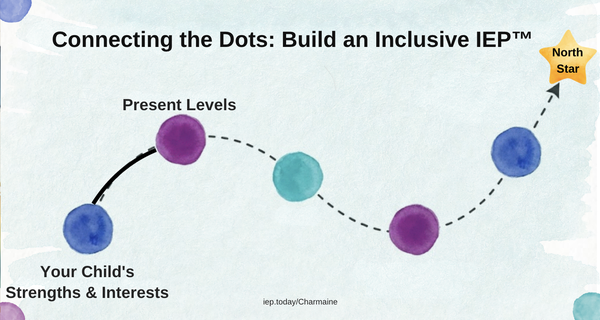
What You'll Learn in Connect the Dots: Build an Inclusive IEP™
In our second session together, I'm going to show you something different.
We're going to take the laundry list of what your child "can't do", and we're going
to reframe it.
Not to minimize challenges. Not to pretend supports aren't needed. But to describe your child's needs as conditions for success instead of a record of failure.
Because the way a need is written in the Present Levels shapes everything that comes after it. It shapes the goals. It shapes the accommodations. It shapes whether the team sees your child as someone to fix, or someone to teach.
Here's what I mean.
Instead of: "Has difficulty staying on task during group work." Try: "Sustains focus and participates more fully when given a defined role in a small group of familiar
peers."
Same child. Same classroom. Completely different starting point for the conversation.
Instead of: "Does not follow multi-step directions." Try: "Responds successfully to one-step directions with visual cues; ready to build to two-step instructions with consistent support in place."
Instead of: "Struggles
with written expression." Try: "Communicates ideas clearly and in detail verbally; needs structured support to transfer spoken ideas to written form."
Do you see what happened?
Every one of those reframes does two things at once. It tells the truth about where support is needed. And it opens a door toward a strategy, a strength, a place to start.
That's what a Present Levels section needs to do.
When it's written that way, the whole IEP changes. Goals become more purposeful. Accommodations stop being a generic checklist. And the team has something real to build from, your
child's actual starting point, described in a way that points forward instead of just naming what's missing.
Come Build This With Me
Yesterday, I sent you the newsletter about strengths and how they critical they are to the developing of your child's IEP.
Present Levels is the next dot.