You’ve probably heard this advice before:
“Write your parental concerns before the IEP
meeting.”
“Email your input to the team.”
“Attach your strengths to the document.”
As an advocate, I used to give that
advice.
Not anymore.
Here’s why.
At best, that advice gets your words typed into the Parental/Student Concerns box near the beginning of the IEP.
And then… that’s where they stay.
You don’t need worn-out advcacy advice.
You need strategy.
You need to understand the difference between your input living in that one small
box at the beginning of the IEP…
…and your input being woven throughout the entire document.
If it only lives in that one box, it doesn’t drive the
plan.
And if it doesn’t drive the plan, it doesn’t change your child’s day.
Here’s the reality:
The district is accountable for what’s written in the IEP, not the email you sent.
If your input isn’t written directly into the actual sections of the IEP, it can be ignored.
Once you understand that, your advocacy shifts from reactive to strategic.
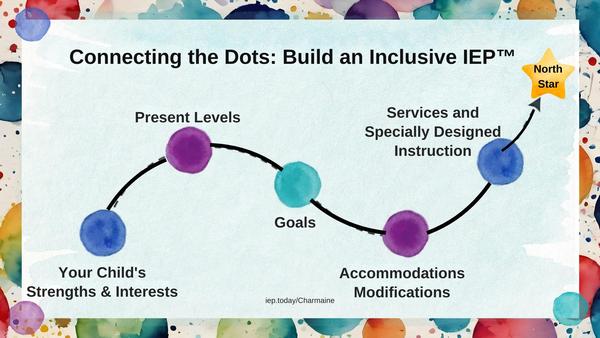
And that’s where the dots come in.
An IEP isn’t just one document.
It’s a series of connected sections:
🔵 Strengths.
🟣 Present Levels.
🟡 Goals.
🟣 Accommodations and Modifications.
🔵 Services and Specially Designed Instruction.
Think of them as five
dots.