The moment in IEP meetings that is worrisome:
You’re talking.
You’re explaining what actually helps your child.
You’re naming what causes shutdowns, what lights them up, what gets in the way.
And then you notice...
No one is writing it down.
People are listening. They’re nodding.
But the part that really explains your child,
what makes things hard or helps them succeed, often doesn’t get written anywhere.
And later, when you read the IEP, it barely sounds like your child at all.
If this has happened to you, it’s not because you didn’t explain things well enough.
It’s because the system doesn’t automatically capture what you know about your child and that's a problem.
Why “About Me” pages don’t change much (even when they’re thoughtful)
You’ve probably tried an “About Me” or learner profile.
It’s a good idea.
It helps teachers see your child as a whole person.
But here’s the hard truth most parents discover too late:
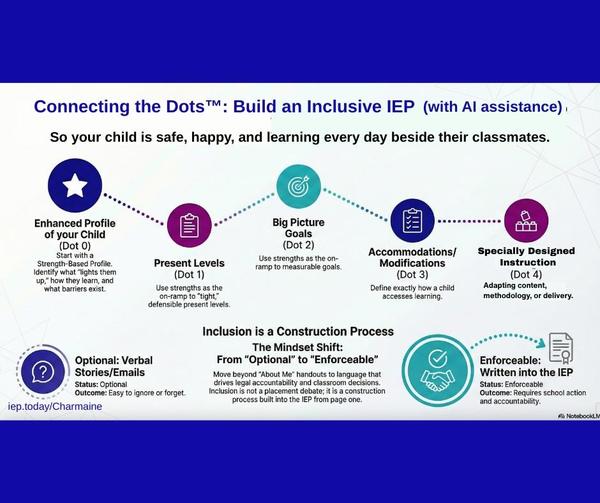
If that information isn’t connected to the IEP, it stays optional.
It might be read once.
It might be
appreciated.
And then it disappears into the day-to-day chaos of school.
Optional information doesn’t drive instruction.
Optional
information doesn’t shape services.
Optional information doesn’t protect access to general education.
Where things actually start to change
The shift happens when what you know about your child is no longer just a story, but becomes written language that connects directly to the IEP.
That means:
🔴 strengths that show up in present levels
⚫ learning needs that clearly point to supports
🔵 patterns that justify
accommodations
🟤 instruction that matches how your child actually learns
This is the difference between being heard and being written in the IEP that shapes your child’s day.
Why AI helps here (and why this isn’t about tech)
This isn’t about replacing your judgment or your voice.
It’s about reducing the mental and emotional load of turning everything you know into something usable.
AI helps because it can:
🟢 capture your child’s full learning story faster
🟠
organize scattered insights into clear patterns
🟣 put things into writing you can reuse
🟡 reduce the pressure to “get the wording right”
🔴 you can even speak instead of type,using voice-to-text and let the tool do the heavy lifting of organizing your thoughts.
What matters most is this:
Once your child’s learning profile exists in a clear, written form, you stop starting from scratch every time.
What this makes possible (in real life)
Once you have a rich, usable profile of your child, several things start to shift naturally.
⚫ It becomes easier to connect strengths to the IEP.
Not abstractly, but in specific language that
fits present levels, goals, and supports.
🔵 AI tools stop being generic.
When you use AI for school-related tasks, the tool can finally respond to your child instead of a generic “student with needs.”
🟤 Teachers understand your child faster.
Clear, skimmable summaries help teachers get up to speed without guessing, especially in the first weeks of school.
🟢 Instruction improves without extra meetings.
Teachers can use the profile (and AI, if they choose) to design activities that better match how your child learns.
🟠 Homework nights and virtual days get easier.
You’re no longer improvising support, you’re working from a clear picture of what actually helps.
Why watching the demo matters
This is one of those ideas that makes sense when you read about it, but clicks when you see it happen.
In the video, you can watch how:
a learning profile comes together quickly
that profile turns into IEP-ready language the output can be refined so it actually sounds like your child.
That’s exactly why I built the custom GPT, This Is Me! 2.0.
I didn’t create it as a generic AI tool. I built it specifically for parents — because parents already carry so much knowledge about their child, but rarely have an easy way to get that knowledge out of their head and into
usable, written language.
In the video, I demo This Is Me! 2.0, a custom GPT tool I created specifically to
support you.