Have you ever left an IEP meeting feeling relieved?
The school team said your child would be
included.
The percentage of time in general ed. sounded right.
Everything looked good on paper.
And for a while, you savor that
relief.
.
Weeks go by, and something starts to feel… off.
Your
child is technically in general education,
but you start to notice things like...
💥They talk more about the special education teacher than the classroom teacher.
💥Work comes home that’s clearly too hard, or so modified it barely resembles what the class is doing.
💥You’re told things are “going well,” but you can’t quite picture what your child's day looks like.
Nothing is wrong, exactly.
But something doesn’t add up.
And you find yourself quietly wondering:
Is this what inclusion is supposed to feel like?
If you’ve been there, I want you to hear something clearly:
You
didn’t misunderstand the meeting.
You didn’t miss a step.
And you’re not imagining the gap.
This is something I see all the time as an advocate, and it’s tricky, because on the surface, it looks like success.
I call it the illusion of inclusion.
Not because anyone meant to mislead you.
But because the system often confuses time with access…
and
placement with belonging.
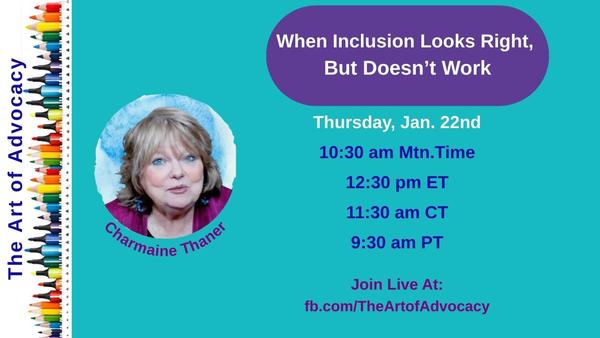
This Thursday, I’m hosting a short 15 minute episode of The Art of Advocacy with a Q&A afterwards, called
“When Inclusion Looks Right, but Doesn’t Work.”